EDWARDS AIR FORCE BASE, Calif. -- Rapid technological advancements have been reshaping the flight test landscape, especially with the integration of artificial intelligence-enabled autonomous systems. In alignment with this rapidly evolving environment, the United States Air Force Test Pilot School at Edwards Air Force Base, California, has been refining its testing methodologies and partnering with international allies to safely and effectively evaluate the emerging cutting-edge aerospace capabilities.
In April, Air Force Maj. Richard Agbeyibor, the school's assistant dean of faculty for research, traveled to Prague to participate in a critical NATO Science and Technology Organization Research Task Group meeting. The multiyear initiative, co-led by the United States and Sweden, brings together experts from across the alliance to address the complex challenges of integrating drone swarms into the modern battlefield. The task group focuses on the emerging field of human-swarm interaction, working to formulate comprehensive guidelines for the command, control, design and operation of unmanned swarms across NATO forces.
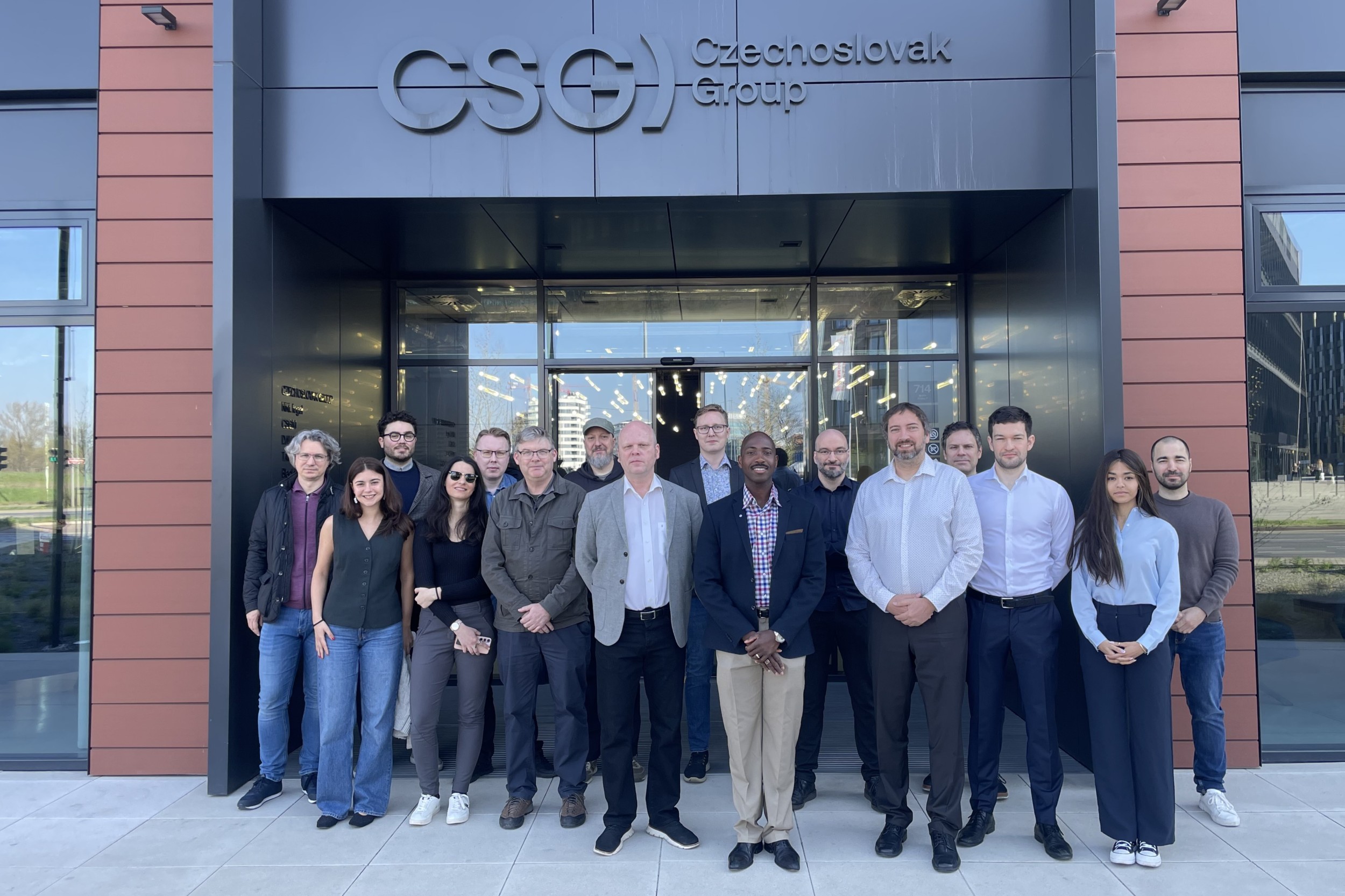
Attendees from the NATO Science and Technology Organization Research Task Group pose for a photo in Prague. (Courtesy photo)
Shifting from traditional, direct operator control to a new paradigm of nondeterministic, intent-based control has quickly become one of the most critical challenges to solve as warfighters learn to manage and trust systems operating with high autonomy. Agbeyibor noted that when an operator is managing a swarm of dozens or hundreds of unmanned systems, direct control of every single asset is impossible. Instead, the operator must transition to intent-based control, commanding the swarm to achieve an objective while the AI manages the execution. From a test and evaluation standpoint, this introduces massive complexity because the system's responses are nondeterministic.
To address this complexity, the USAF TPS emphasizes testing the human operator and the swarm together as a single, cohesive unit, heavily relying on iterative cycles of advanced modeling and simulation. Integrating these modern test concepts into NATO's operational guidelines is vital to ensuring coalition interoperability in future contested environments.
The USAF TPS is one of only seven globally recognized flight test schools, establishing a distinct international footprint.